Thursday, September 15, 2011

Cockenoe Is. vs Irene

The Cockenoe Island Sand Spit did not fare well in it's recent bout with Hurricane Irene.
All of the islands vegetation is gone as well as a foot or so of the top of the spit.
Above is an old metal post, one of many that was exposed with the removal of the vegetation.
My guess is that these were part of a dune grass protection fence from a few decades ago.
Seems like I remember something of that sort.
In this post Irene picture we are looking south. You can use the back round trees as reference point for the next photo.
This photo is the same part of the spit, from summer of 2010.
Here is another shot from 2010, this time looking north towards the mainland.
Same north facing shot, after Irene.
Check out the small dark projection in the middle of this photo.
It is what was left to the root system of one of the beach plants, this root is about a foot or more in height, it is easy to see where the plant snapped off and how much erosion took place in order to expose the remains of the plant.
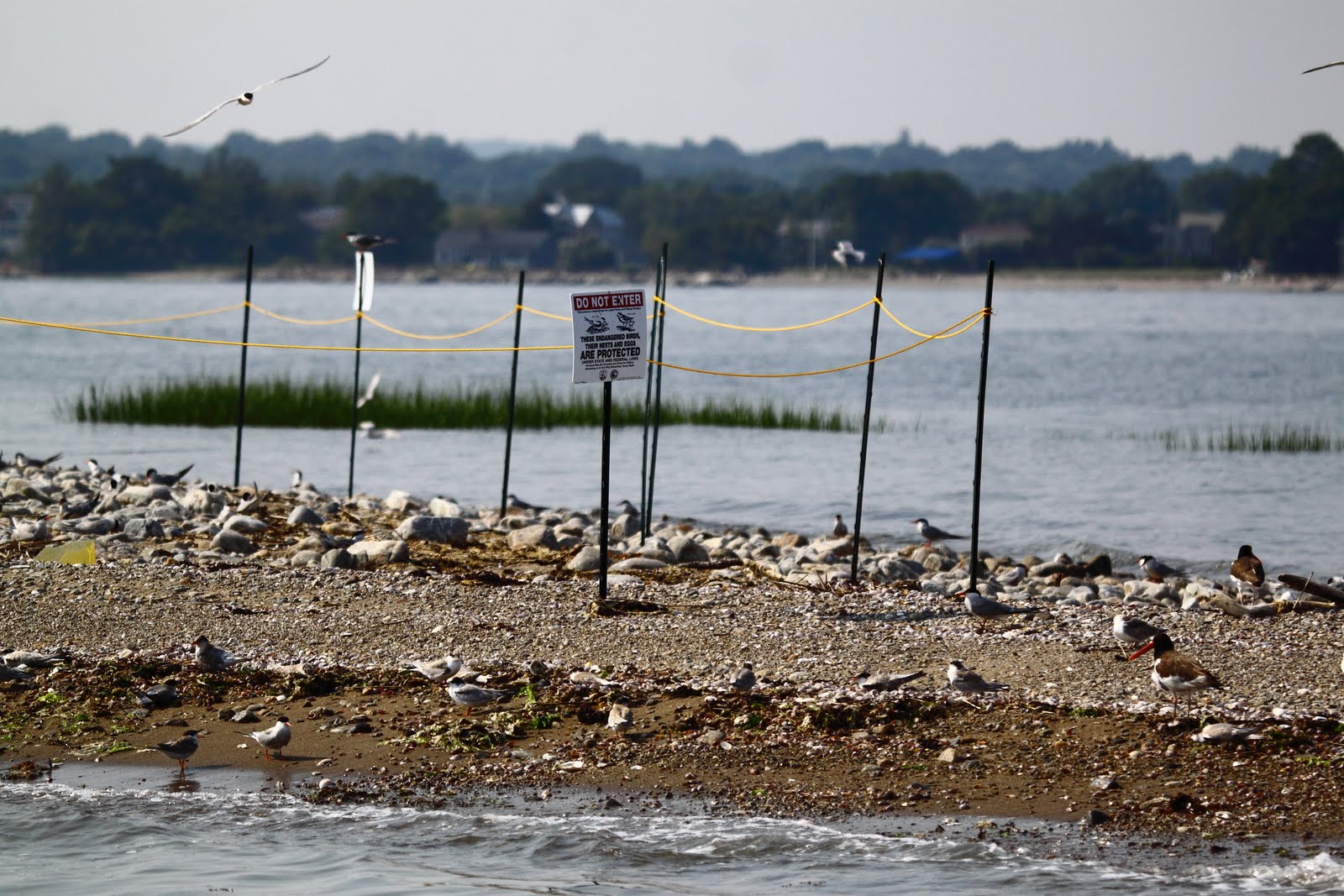
The USFW bird fencing has been either ripped out or snapped off and is now on the eastern side of the island.
The metal fence post were either bent 90 degrees or snapped in two.
I tried to pull this line out of the ground, impossible!
It is covered over with so much sand and rock, it might take a backhoe to dig it up.
I'll leave it for the next hurricane or for someone else to find in another fifty years
There is still bird life around, I found six American Oystercatchers at Cockenoe and another fifty three gathered on Crow Island, these were some of them.
A half dozen Osprey were feeding in Norwalk Harbor, here is one carrying an Atlantic Menhaden, one of the ospreys favorite dishes. This fish is locally know as "bunker"
There was a feeding frenzy near the Cockenoe Is. sand spit, not only by Laughing Gulls, but a number of Common Terns and Herring Gulls as well. 
The disturbance was from small bait fish being pushed to the top by bluefish.

Thursday, July 21, 2011

It's been a while...

It's been a while since my last post, health issues have slowed me to a crawl for the past several months.
Feeling a tad better, I finally made it out on the boat today for the first time in almost two months.
 Though I spent most of my time scraping barnacles,
I did get some fine birding in at Cockenoe Island, Westport.
Before I made it to Cockenoe, I found these two Long-tail Ducks hanging out on Calf Pasture Island.
A few of these birds may hang out around the islands during the summer instead of migrating north to the arctic to breed. I often wonder, is this because they can't fly?
These are both males and appear to be in post alternate (breeding) plumage
Arriving at Cockenoe, I found about fifteen American Oystercatchers.
In this photo a juvenile is to the left and the adult is on the right.
Notice several difference between the two.
The color of the eyes, bill and back are not the same.The young bird is changing it's look fast and soon it will be the same coloration's as the adult.
In the islands back bay I couldn't miss all these egrets.
I counted 127 in this area, the camera missed a bunch on either side. Elsewhere on the island
I easily found another one hundred.
These are mostly all this years youngsters as there is a good size rookery here.
The majority of this flock are Great Egrets with a few dozen Snowy Egrets mixed in.
I didn't look up close, I'm sure there were other heron species here also.
The Sandspit.
US Fish and Wildlife took care of the fencing this year.
Judging by the hundreds of young Common Terns USFW did a great job protecting the colony.
I did not see any Least Terns out here today, they started nesting here in late May but did not succeed and move on.
Another view.
A few laughing gulls on the sandbar leading to the sand spit.
Note the three different plumage stages between the four gulls.
With ninety degree temps today, these six Common Tern hatchlings found the only shady spot on the sandspit.
Todays surprise was this Whimbrel mixed in with several Willet.
Whimbrels do show up as individual birds almost every year on Cockenoe in late July and August.
The calender say's we are almost into August, yet this female Osprey is still adding to her nest on one of the local lighted channel markers.
Her mate is perched above to the right and she has three chicks in the nest.
Those three chicks appear to be wondering " where's the fish, we can't eat any more of the darn sticks"
The third chick is way to the right, almost hidden.
I hope to be back soon.

Best to All!
Larry

Friday, April 1, 2011

Horned Orioles?

The pair of Baltimore Orioles that have wintered over in my Norwalk CT backyard are looking a bit ragged these days.
Check out the A bird in molt, of course it's not a Horned Lark, but it is this oriole's best impression of one.
Last week around 3/22 I noticed a difference in the two orioles, I thought perhaps they were sick.
Worried like the Mother Hen that I am with these two, I almost freaked out.
I started photographing them and talked to bird rehabbers, soon I saw that this was just a molt.
Wow, I could relax.... I am now photographing them daily to show the progression of the molt.
Something that is rarely seen in wild Baltimore Orioles in these parts, since they do this molting process  before they return to New England.

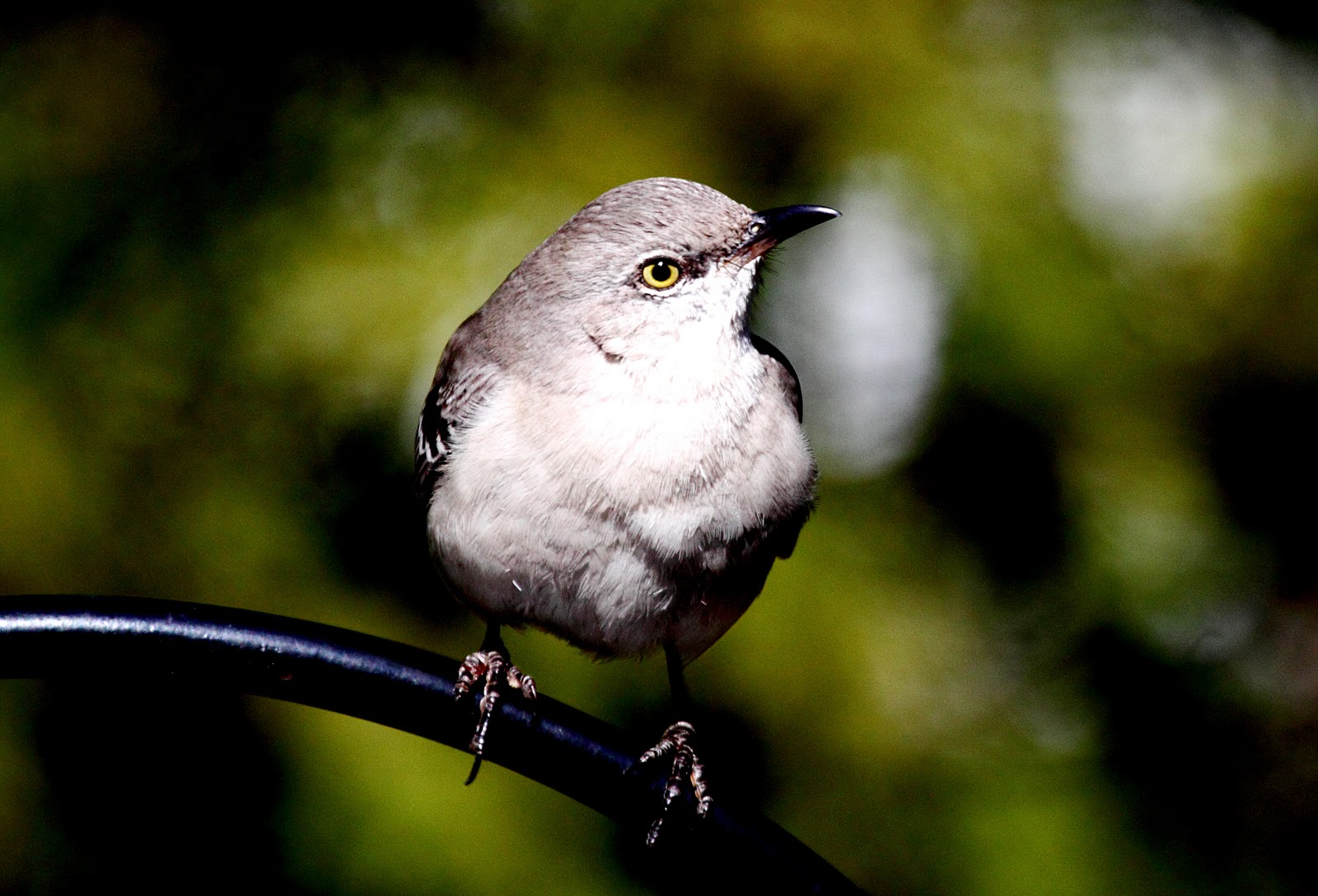
Hanging out near the Oriole feeders, is one of my best backyard bird friends, this Mockingbird is doing it's best Cyclops Mockery.
This bird is very friendly and is always in line for a few meal worms.
Of course all these birds need someone to look out after them when I am not around.

This dude gladly volunteered to keep watch over my flock.
I found it in the neighbors magnolia tree this afternoon, just yards away from the Oriole feeders.
I kept shooting and shooting with the camera, getting closer and closer, this bird had no fear of me.
I walked directly under this Sharp-shinned Hawk, just feet away,  it still would not flush.
I checked under all the evergreens, I did not see any feather piles...
I also did not see the Orioles for the rest of the evening, yet their meal worms disappeared while we were not watching, I'm sure they are fine, they deal with these raptors daily.

Remember that 60's song by Sam the Sham and the Pharaoh's.
"Hey there little Black Vulture Bird, you sure are looking good"
Found this lone bird in Fairfield on 3/29 keeping watch on a roadkill raccoon.
All right, it's Little Red Riding Hood, don't get upset Sam.

This past Saturday, I was the guest on Chris Bosak's "Bird Call's" radio show.
This is Chris in action in the above photo at the WNLK/WSTC Studios in Norwalk.
1350/1400 AM.
The show broadcast live each Saturday from 3-4 in the afternoon.
If you are out of range or missed the show, they are archived on Chris's website.

Yours truely on the radio, move over Don Imus!

Sunday, March 20, 2011

Plankton, Tows and Gulls


While at the Connecticut Conference on Natural Resources last week, Dennis Varza and I bumped into
Jack Barclay after one of the classroom sessions.
Jack mentioned that he would like to collect plankton samples off the coastline from Norwalk to Stratford.
It took no arm twisting at all to have me fire up the outboard and start this St. Patricks Day journey.
Instead of being at a parade with marching bands, pipes and drums corps and others, we ran into a different parade, this one was of gulls, thousands of them along with hundreds of other birds, such as brant, black duck, and scaup, all feeding on the microscopic life we know as plankton.  

They all had one thing in common, that was to feast not on corned beef, but the bountiful masses of the various plankton that were afloat to the waters surface.
It was easy to find the plankton, just find the birds
Jack provided all the equipment needed, most importantly this plankton seine.
We would  make a slow troll with it at about two knots and for several hundred yards before hauling it back on board.
This bottle at the end of the net is the capture tank that holds everything we gathered on the trawl.
As you can see, it is past being full.
Jack and Dennis  preparing to unscrew the bottle.
Then empty the contents into a plastic bag.
Thousands and thousands of microscopic living animals (zooplankton) and plant life (phytoplankton) abound in this small bag.

Bags are quickly labeled and put on ice, data entered includes Lat/Lon,
time of drag start and finish, water temp, air temp, wind direction and velocity.

The seawall off Stratford's Lordship Point.
Birds were gourging themselves along the beach from this seawall on east to Stratford Light House. 

More microscopic gull food
Bonaparte's Gull were numerous around the plankton blooms
The entrance to Bridgeport Harbor easily had the largest number of birds feeding on the plankton today
These four pictures could be put together for a panoramic view of the thousands of birds around the boat.
Seaside Park
Just outside the breakwater.
Barnacle larvae attaching themselves to the glass jar.

Penfield Reef was another popular feeding area.
The main reason for this trip was not just to gather plankton, but to gather them for a purpose.
Not to simply identify different species, but for scientific study.
These samples are all going to a lab, where scientist will be testing them for toxins.
When and if I have results, I will post them here. Hopefully soon.

This last night of winter's full moon.

Sunday, February 20, 2011

Great Backyard Bird Count by Boat

The Great Backyard Bird Count started today, and what a day they picked to start this event.
At least in Long island Sound that is.
My friend Alvin join me on this trip, we left the dock at 08:20 2/18/11
with calm winds and above freezing temperatures.
We started today's count on the western side of the islands at Greens Ledge Lighthouse, this reflective photo shows the calmness in the air, what it doesn't show is the temperature.
The thermometer was rising rapidly on the mainland, yet out here I doubt we ever felt anything more than high thirties at best, the sound is still an ice box and does not warm as well as land. 
We drove out to this Light house for a reason.
Cormorants.

Great Cormorants use these rocks that surround the Lighthouse as a perching area during the winter.
A look at the massive amount of white-wash shows that this is a popular resting place for these birds.
In total there were seven Great Cormorants here when we arrived.
Before I forget, left click on any of the photo's to enlarge.

 Leaving Greens Ledge we headed eastward, not but a mile past the the lighthouse, cruising at 25mph I passed very close by to what I though was a lobster pot.
Alvin yelled OMG thats a seal!
I turned and looked, yes it was.
My problem here is why didn't it move or submerge?
They don't do this, I figured it was sick or injured.
I turned the boat around and pulled out my cell to dial either Norwalk or Mystic Aquariums,
for help.
The seal, head out of water never moved or flinched, as you can see from the above photo he appeared to be just sleeping, eyes are closed. This is something they do, just tread water and zone out.
Apparently this is what was happening here, as we came closer to this Grey Seal, it's huge eyes slowly opened, seemingly without a care in the world, he lazily looked at us and slowly turned, arching it's back and giving us a whale roll disappeared below the surface. 

At first this looks like a rock in the water, but it is the rump of our almost 800 pound 10 foot long Grey Seal, submerging into the depths.
Check out how the water never leaves contact with the seals skin.

Just beyond the seal is Norwalk Seaport Association's Sheffield Island Lighthouse, in winter plumage.
The windows are buttoned up, plus there is still a good bit of snow on the ground.
This Lighthouse and Sheffield Island can be visited during the summer months via the Seaport's Ferry service on the C.J. Toth. 
Visit their site here: http://www.seaport.org/
While your there, check out the Bird Cruise info.
Come onboard and join the Seaport and I for a great trip and some awesome views of the Norwalk Islands and its incredible wildlife this coming spring and summer.

Bird Counting was the reason for this trip, we had great numbers of several species.
Almost 600 Long-tail

800 greater Scaup (above photo)

Brant numbered close to 900.
The Seaducks, Brant, Goldeneye, Scaup, Scoter, plus Black Duck and others are expected around the Norwalk Islands and Long Island Sound during the winter.
What I never expected, showed up on Cockenoe Island.
From the boat I picked out one small finch/sparrow like bird that flittering on the shoreline.
I maneuvered the bow of the boat onto the shoreline, where I saw a number of small birds moving about.
Song Sparrows? Horned Larks? Snow Bunting? Savannah?
Lapland Longspurs?
All these were calculating in my head, what could they be?
Then I saw my first good look thru the bins.


Common Redpoll on Cockenoe Island, no way!
Here they were, on Cockenoe Island, one mile offshore, feeding on seed heads from this past years
seashore plants.

They were in numbers, a minimum of forty five, maybe fifty.
Redpolls feeding along the slipper shells?
On a island in LIS?

This is Oystercatcher and Tern nesting ground. The last bird I would expect out here is the Redpoll, a arctic/sub arctic nesting bird of the conifers and scrublands.
They are never common in Connecticut, yet during occasional winters they will erupt in this State.
So far this winter, there have been a few reports in Connecticut, but mostly in areas inland from here.
They do show on rare occasion at Sherwood Island State Park, not but a few miles from here, but that is on the mainland. I guess they have no issue about flying a distance over water?

East White Rock came through again with ten Purple Sandpipers.
After big time search efforts, no other shorebird species were found.
Although we had a Killdeer on Chimmons this past Wednesday.

Great Cormorant numbers were at 14.
Status Quo for them around the islands this time of year.

As I mentioned in my last post, the Great Black-backed Gulls have moved back to their nesting islands, these birds are hanging out on the northern bar at Goose Island.
That is Peck's Ledge Lighthouse in the back round

Same lighthouse and same sandbar from a few years ago.
When Goose Island played host to this Snowy Owl for a few days.

I know its mid February, these gulls were not here a week ago, now there are almost 200 on the two nesting islands, looks like they are setting up shop to me.

This is the salt marsh behind the Norwalk Power Plant.
With the extra high tide this place was alive with water fowl.
Besides the Geese and Black Duck that are seen in the photo, Wood Duck, Northern Pintail, American Wigeon, Gadwall, Mallard, Green-winged Teal and others were abundant in the area