Thursday, July 15, 2010

The Terns Survived

After this weeks new moon tides, three 8.5 and one 8.6 tide, I had to think that the Cockenoe Island Tern Colony had to have been devastated, a look around at low tide on Tuesdays, Norwalk Seaport Associations Bird Cruise didn't reveal a whole lot of birds.

We could see where the previous night tide line came up to, there was very little island left above the tide line, if a bird couldn't fly away it may have been swept away by the extra high tide and the currents.


I had to get a better look at high tide, when I can get my boat very close to the island.

I already knew that the Least Terns nest went underwater, as they play Russian Roulette with the tides, yes these nest were gone, but as I peered closer, I could see life on this tiny sand spit, and a whole lot of life there was.


I counted one hundred Common Tern chicks , there were more, I was so impressed to see that these chicks survived, I stopped counting them and started looking for Least Tern chicks.

On the southern edge of the island, there they were, first one, then two, three, four , five, perhaps a dozen made it, alright!


Though their nest have been wiped out twice from big tides, this Least Tern seems to want to try again. Again well below the tide line. Recognize the coffee cup in the backround?


The adult American Oystercatcher is to the left, note the bright orange bill, yellow eyes and orange eye ring. The youngster in the middle still has black in its bill and has dark eyes and no eye ring.
Click to enlarge any of these photos.


Here is one of the few Least Tern chicks that survived.

Least Terns are on the Threatened Species List in Connecticut, and are on the Federal Endangered Species List in other parts of the United States.


This herring species fish is now dinner for one of the hundred or more Common Terns chicks running about.


Common Tern chicks are at all ages out here, this one has fledged and can fly short distances.


They are loud and cranky, I was target practice. They won!


A younger Common Tern chick, huddling up to an old Lobster pot buoy.


Adult Common Tern in the backround, with it's chick in the foreground.


I know its hazy, hot and humid, but talk about a bad hair day.

This young oystercatcher is learning to preen its feathers.
Edward Scissorhands?


Part of the Heron Colony out here. On a recent survey that I was part of with CT DEP

108 Great Egret nest were counted, 27 Snowy Egret nest, Glossy Ibis and Little Blue Heron had five nest each plus a number of Black-crowned Night Herons.

These areas are off limit to the public, they are NASTY, filled with poison ivy, broken glass, vines prickers, and stink beyond belief!
Please don't even think about it.


Besides, most of the colony has fledged, these birds are now feeding inside the bay at high tide.
There were over one hundred herons and egrets feeding here.


I keep checking on these dudes, I cropped the third bird on the left out of the picture, as I was awed by this pose.


A bit more cropping, incredible!


This is The Norwalk Seaport Associations brand spanking new tour boat, The C.J. Toth Quest.

At 45 feet, it is an incredibly comfortable vessel. If you have any interest in seeing the wildlife around the Norwalk Islands, or even just a nice three hour get away, book a seat on this boat for one of the very popular bird cruises, I promise you won't be disappointed, it's quite awesome.
In the backround is the Seaports Sheffield Island Light House which can be visited daily.

Visit http://www.seaport.org/ for times and reservations, for both the Lighthouse and the Bird Tours.

Thursday, July 8, 2010

A Backyard Pool Party, For The Birds!

It was just too hot to be on the water this week, I checked the sand spit Tuesday morning and all is well. In the meantime it wasn't just you and I that thought it was HOT!
Let's get out of the sun and take a quick look at the backyard at our house.

A number of years ago, I installed a flowing water bird creek in our back yard, it was always a magnet for birds, but it had served its purpose, it was time to do something a bit different.
This spring I pulled it out and did something a bit different, it was still based on a waterfall or two, but this time it has a bigger, deeper water pool, about a four foot round by two foot deep pond.
In here are a few Koi, Goldfish and water plants and a fountain.
Surrounding the pond is a shallow, one to two inch deep bog area, with a number of shallow water plants, this is the playground for many of this years fledged and adult birds.

With the heat wave, and drought that we are currently experiencing, this has become pool party central for the neighborhood birds, the adults have always brought their fledges here to drink their first water and take their first baths, but with the expanded area that I installed, more and more have come, especially in this heat wave.
At night I have also see skunks, raccoons, opossum and others come in for a drink.
A short-tail shrew has also adopted us, we see him in the daylight often.
This is the lower pond area, it a few feet deep and four feet around, Goldfish and Koi are visible in this photo.
The outside area is the bog, a very shallow area, also with lots of moving recycling water that is a favorite for birds, bathing, drinking or cooling off, it is washed and cleaned daily!
There are two waterfalls and a fountain, lots of aeration, even on these hot days, it stays cool as it only gets an hour or two of direct sunlight.
This is a 24/7/365 water feature, I add a heater in the winter to keep the water fluid, in deep freeze it is very popular, not just with birds but with mammals also, it may be the only open water for miles.

This is the upper waterfall, it flows into a very shallow pool, sort of running brook style,before flowing into the pond. Birds cannot resist it, the sound of running water stops passing birds in flight, to come take a look, a drink and maybe a quick bath.


A side view, we have less than quarter acre lot, the arborvitae and red cedar provide perfect cover for the many birds visiting and nesting in our yard.
Believe it or not, I have had 8 and 10 point deer, right here.


Fox Sparrows are common bathers during migration.


These young Common Grackles are possibly my favorite, their parents seem to drop them off here by the truckload, "spend the day in the pool kiddies, We'll pick you back up before dark"
They are precious, but also have to feel everything with their bills, they are chopping down my Pickerel Weed, and chewing up every plant in the bog. But that's OK!
In Wednesday's heat there were sixteen birds in the bog at one time, all youngsters, Catbirds, Robins, Grackles, Orioles, Starlings, House Sparrows.
We have several other bird baths in the yard, without moving water, Goldfinches and others seem to appreciate these.


Tail-less Catbird at Oriole feeder.
These Oriole feeders are very hot right now, the bottom is filled with sugar water, 1 part sugar to 4 parts water, boiled, stirred and refrigerated. Hummers love it also!
Where this birds feet are, there are trays that I fill with Poloners Grape Jelly, this is natural jelly, with no artificial sweeteners, (the chemical stuff is not cool and may harm these guys) and of course a half an orange.
Beside the Catbirds, It is the place to be if you are an oriole, I've had up to six males, six females and all their kin fighting for a spot at these feeders, and right now is the time to have these feeders out..
You will also be surprised at the number of other species that show up on these feeders.


Where's the Fruit?


I also keep thistle and shelled nuts out during the summer, goldfinches are here daily, sun up to sun down feeding on the thistle, unsalted peanut halves are a easy delicacy for many birds, including this recently fledged Red-bellied Woodpecker.
Happy Backyard Birding!


Saturday, July 3, 2010

July 4th, no holiday for nesting shorebirds

The 4th of July is official start of summer, but if you are a shore nesting bird, this time of year can bring tragic loss to young hatchlings, and unhatched eggs without a moments notice.
Offshore islands now become the summer playground for thousands of boaters in the Norwalk area.

With the many boaters, kayakers, surfboarders, PWC operators and others now using the shoreline areas around the islands for their enjoyment, birds species that have set up nesting sites weeks or months ago when all was quiet, are now in jeopardy of losing this years clutch of offspring.

Places like Sandy Point, in West Haven, rely on volunteers to monitor nest sites and keep firework watchers and others from trampling through these areas.

It is no different in the Norwalk Islands, except there are no monitors, the wildlife and vegetation are pretty much on there own out there.
I spent a few hours Friday evening, it could have turned ugly, but that was avoided.
I left Cockenoe Island as the sun was setting, all seemed quiet. But this was just the start of a long weekend!
Click on any photo to enlarge.

An unsuspecting kayaker paddling close to shore, flushed this flock of nesting terns.
This often happens, and the terns put up with it, as long as people don't walk onto or get near the nesting area

This American Oystercatcher fledgling has now reached adult size, but has not grown its flight feathers and cannot fly, it is easy game for a loose pet.


So would this young Killdeer, these birds are less than six inches tall, stones and shells are mountains to them.


This Piping Plover chick is almost invisible with it's surrounding habitat, if they can't run away they will freeze in place. Many are trampled on each year by unsuspecting beach goers.


These recently hatched Common Terns, again very hard to see, can't fly and have very short legs, it would be impossible for them to flee from any predator, including humans, that could walk ontop of them since they become almost invisible with the shoreline.
These are just some of the birds that need our help when we are along remote shorelines.
One loose dog can kill many chicks and eggs, I know, I've seen it happen.
It's up to us, to protect them, and let life move on.


While two of this Herring Gulls siblings walked off into the vegetation after seeing the boat, this one chose a different maneuver, He'll just swim away.
A Q/T


Just opposite the young Herring Gull was a Glossy Ibis feeding in the marsh.
On a recent survey that I was a part of with CT DEP at least five Glossy Ibis nest were found around the Norwalk Islands.
I will report on the others after the nesting season is over.


Willet are becoming more common as most their young have now fledged.
Nice photo to left click on.


The food source was not far away, as a school of bluefish were blasting baitfish near Peck's Ledge Lighthouse.
This was a repetitive route, ongoing throughout the evening by hundreds of terns.


This is of concern, these youngsters were pounding the fragile beach vegetation with sticks.
I gave them a holler and they stopped, but they then started walking off towards the tern nest site.
Fortunately they turned around within just a few hundred feet of the site, and went back to their
campground or boat.
I had visions of this crew treating the terns as pinatas. Oh Boy!
This is why enforcement is needed. Law Enforcement that is, not me!

One thing I do understand is "boys will be boys"


As the sun was setting, I caught this last tern, returning to it's nest.


Friday, June 25, 2010

Here Come The Babies

I only had a few moments to check on the tern colony at Cockenoe Island, as I was motoring out Norwalk Harbor, I couldn't help but notice an osprey hovering and then stooping, it was a quickly repeated movement, I put the boat in neutral and stood fast.


What this female osprey (the one in the above photo) was doing, was following a Double-crested Cormorant that was searching sub surface for a fish or two for lunch, the osprey would hover, following very slowly, just before the cormorant would surface the osprey started it's stoop from fifty or so feet, and meet the cormorant with talons extended as soon as the cormorant surfaced.


I watched six stoops, the corm never came up with any food and finally the osprey retired to her nest. My photos were way too out of focus to show.


The Cockenoe Island sand spit is a very busy place right now,

The Least Terns are renesting after their loss of nest and eggs from last weeks moon tides.

The Common Terns are doing very well, since they nest just a bit higher in the sand than the Least, in the bottom middle of this photo is a few day old Common Tern chick, with parents on either side scolding another tern, telling it not to land here.


Bottom bird is an adult Oystercatcher with it's three healthy chicks above, the youngsters are quickly molting into adult plumage, but still have dark colored bills.
Their bills will slowly change to the bright orange of the adult in the nest several months.
You saw these same chicks a few weeks ago on past blogs.
A few pair of Oystercatchers that lost their clutches are now renesting.


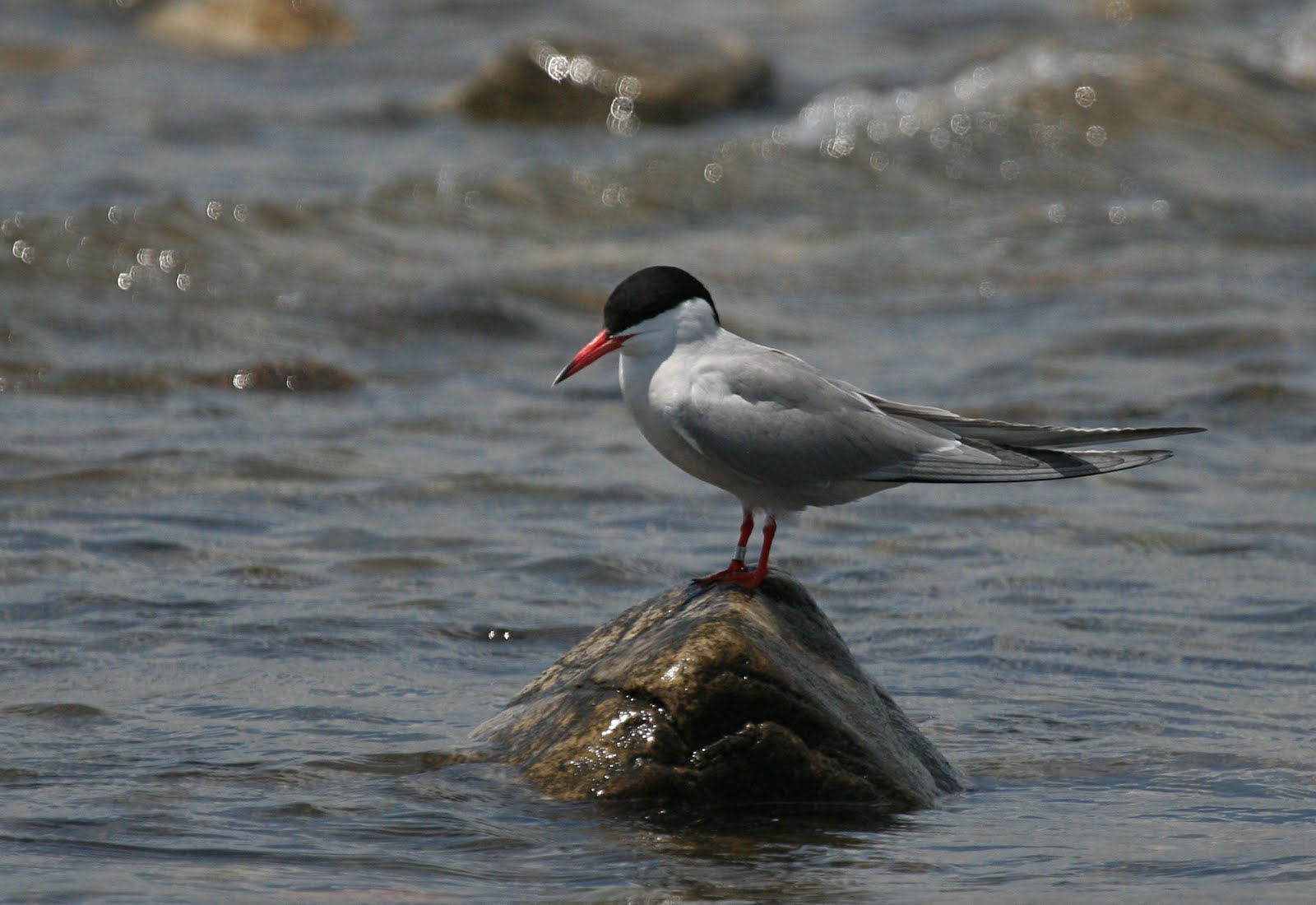
There were about three hundred Common Terns around the sand spit today, this seems to be an ordinary photo of a C Tern posing on a rock.

Click on the photo to enlarge and note the banding ring on its leg, my closeup shows a possible letter H on it.

I have yet to research it but I will. If anyone has the data on hand, please chime in.


I'm cruising along and note this Great Egret flying side by side with the boat, I snap a few shots, then realize it's flying the same course that I am navigating, we stay together for over a mile.

I look at the boats GPS and see that the bird and I are cruising at 19.2 knots, with a 4-5 kt head wind off the birds and my port bow! In mph this puts us at about 22mph.
These birds fly very leisurely, I've had races with Bald Eagles and many other birds that blow by me when I'm over 30 mph, and those birds were not cranking it up.


Osprey chicks are starting to show, this undisclosed local nest is not far above the high tide line.

Note how the chicks lay down to become one with the nest.

Please don't get upset that I was to close to the nest, again I am shooting at 400mm and these pics are cropped most likely past 2-3,000mm, Photoshop helps big time with the clarity.


If it weren't for the orange eyes they would be invisible.


This Great Blacked-backed Gull chick is now learning to hang out in the one to two inch surf.


By the wetness of it's feathers, I'm guessing a boat may have come by, leaving a wake large enough to give this bird a bath? Or maybe it just took one?

Sunday, June 20, 2010

Black-back Predation

I was just reading "Steve's Bird's"

In his blog he talks about a missing Piping Plover chick and the possibility that it was taken by a Great Black-backed Gull, as there were several present in the area.

This reminded me of something we saw this past Monday 6/14/10 at Goose Island, Westport,CT.

(The photo to the top right is of a week or two old Black-backed hatchling, they are very cute at this stage, as they become older, they are still beautiful, but.)

Beware, it gets ugly and graphic from here on in.


You may recall this GBBG feeding on a Black Duck from April.


And this spat with the Corms from May. Now it gets bad,
PLEASE, DON'T LOOK IF YOU HAVE A WEAK STOMACH!


My guess is that this is an Oystercatcher Chick, that the gull is having a problem devouring.
I have been watching the Oystercatcher families, most had three chicks to start, some still do,
other families are down to zero, one or two chicks.
The Black-backs are never far away when easy pickings are around.

This is all part of nature, sad yes, but no different than a Red Tail Hawk grabbing a squirrel, a Sharp-shinned eating that lovely Junco in your back yard, or a Chimney Swift polishing off a few insects above the treetops.
It happens everyday, and in many cases for millions of years.
The Balance of Nature?

Wednesday, June 16, 2010

Barn Swallows and Boat Anchors

I have been watching them for many years, Barn Swallows arrive sometime in early May, feeding on maritime insects of all sorts, those good old no-seeums, mosquitoes and whatever else that is available.

They enjoy the habitat surrounding the many marinas in Norwalk Harbor, close to the shoreline, lots of bugs to eat, and some cool man made places to make a nest.

They like a place with a bit of cover to build their nest, and many boats in the area seem to be the perfect place for there nest building.

Most boats these days have a built in bow pulpit, this is an extension of a boats bow that usually accommodates the boats anchor, Barn Swallows have found the underneath of these pulpits to their liking as a nesting sites.

It is not hard to follow adult Barn Swallows right to their nest in any marina, as they are busy providing food to their very hungry and demanding youngsters.


The bottom is the boats anchor, the nest is built on top of it,
above is the bow pulpit with the roping.


Note the mud based nest, built on the top of a boat anchor,
beneath the boats bow pulpit, they fill it with many feathers.


Not a good shot, but you can see the open mouths of the hatchlings,
asking me for a bit of food!
Mama was right there to feed them as soon as I passed bye.
The poop is not from the adults, but rather the youngsters, they quickly learn to turn around and deficate outside of the nest!

The only issue here is when a Captain chooses to go boating, and does not realize he/she has a few extra passengers on board!
The swallows seem to use the less frequently used boats, but that is not always the case.