Thursday, March 29, 2012

Barnacle Gulls

My good friend and biologist Dennis refers to them as Barnacle Gulls, and that is not without reason.
An annual late winter, early spring phenonomon occurs on the western end of the Connecticut side of Long Island Sound, from New Haven on westward to Greenwich CT.
In this mostly rocky bottomed area massive plankton blooms occur, for the most part the major player here are barnacle larvae and in amounts that cannot be imagined.
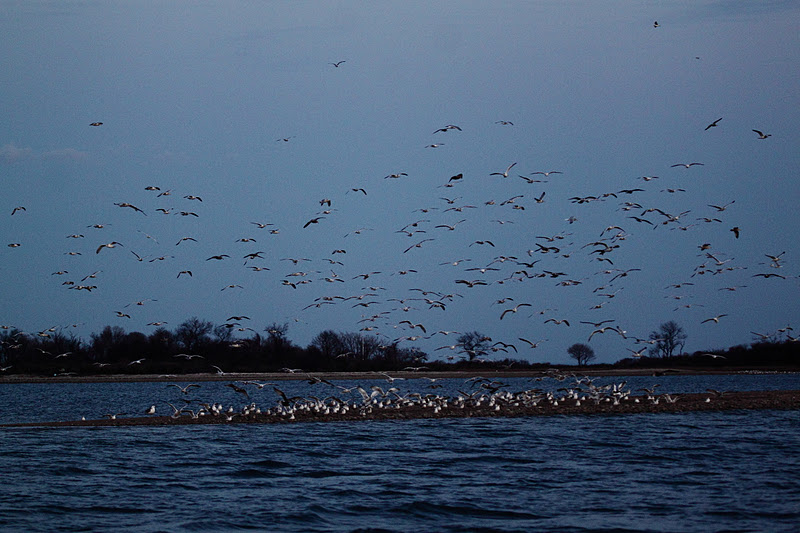
Penfield Lighthouse, Fairfield, CT in the above photo.
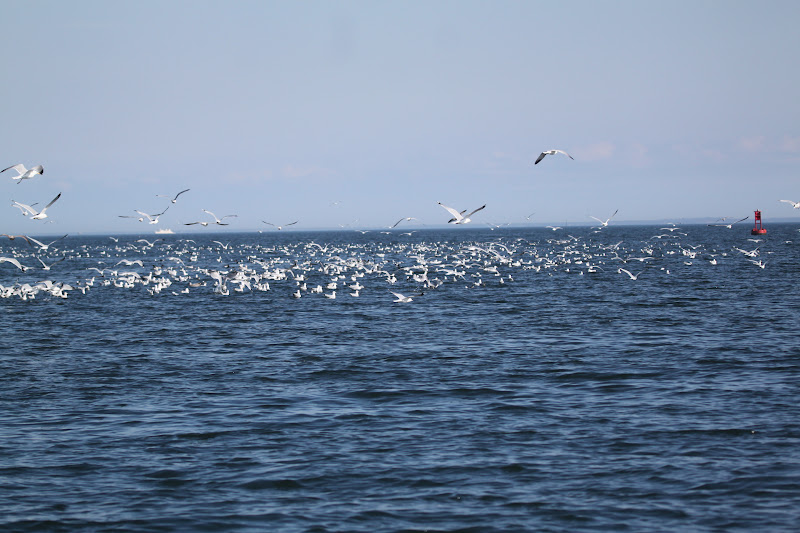
Gulls, mostly Ring-bills and  lesser amounts of Herring are the most involved bird species in counting the plankton mass birds, along with them are  many Greater Scaup, Goldeneye, Long-tail, Brant,Scoter, Black Duck, American Wigeon and a few other species, that feed in the planktonic soup

This area off Fairfield CT, with buoy 22 in the distance, follows a very rock reef, locally known as Sunken Island, this has been a hotspot the past several years for barnacle gulls.
The next few photos are a birds eye view of what they are seeing and feeding on.


These thick plankton masses create a viscious water density, this looks like a calm water slick when viewed from above, but is next to choppy water.
On this trip we did stop in areas where the choppy sea calmed to small flat calm water.
Plankton were always visible in these area's, as were the planktavours.

In this photo of my fish finder, we are in 17.7 ft of water off of Bouy 22. Near the bottom, there is a mass of activity.
Are these other plankton masses? Other plankton feeders, or piscavours?
Herring, Smelt, Anchovies, Striped bass?
One follows the other.
Regardless, this fishfinder photo shows another world happening only a few fathoms below the surface of the  feeding plankton gulls.
This is the world we never see. Any divers out there, that would like to jump in and fill us in?
Your welcome on board!

A Harbor Seal loafing off Southport.

Some of the many thousands of Greater Scaup aloft, with a local shell fishing boat heading home.
Overall the gull count alone was over 30,000 and this trip.

More Scaup off Compo Beach, Westport, CT.

And more.

Back at the dock,  my friends and mentors,
Dennis and Frank.
They are the best of the best.
Always a pleasure to have either of them on board.

Wednesday, February 8, 2012

Norwalk Island Peregrine Falcons

I don't understand the vagrancy of Peregrine Falcons from the Norwalk Islands this past year, and to this day I am not sure what has happened or is happening.
In past winters plus the other seasons, Peregrine Falcons have been a staple around the Norwalk Islands, this past year, from late spring on they have been missing.
Peregrine's are certainly nesting in the area, yet it seems they are no longer interested in the islands.
I have noted that there is a lack of shorebirds in the island chain this winter, yet shorebirds shouldn't be the only food species for these falcons in this area. Do the two go hand and hand?
Since there is no other lack of potential Peregrine prey around the islands, where and why have they just disappeared?

It was just over a year ago that I posted a similar photo of a Peregrine loafing on Cockenoe Island, this is not last years photo, but Saturday's 2/4/12 on Cockenoe!

Again , like last year, there wasn't one but two. This is the second bird....

....that flew over to the first bird and displaced it from it's Styrofoam perch.
Distant in the backround is Green's Ledge Lighthouse, almost four miles away to the west.

The first bird moving off.

The second bird perched on a nearby driftwood log.
With the bird being between me and the sun and casting shadows,
I moved the boat to the other side of the sandbar for hopefully a few better photo's.

Same bird, same perch, much better light.

A closer look.
After a long while this bird decided to move on, it then revealed three bands.


A cropped close up shows the three bands, left leg has two, upper black, lower greenish.
Black number appears to be 192  (?)
Green Number 2?28  (?) 
Right leg is the standard silver band, no numbers seen.

Another flight photo.
It's nice to see this species out on the islands again.
Hopefully I will hear some data from these bands that I have reported.
If and when that happens, I will report on it.

Thursday, February 2, 2012

Gull Kettles

Last month,while fishing for Atlantic Herring off my boat club dock, I watched hundreds of gulls passing south out of  Norwalk Harbor as the sun began to set.
Where are they going? I thought to myself.
A week later, I am back on the docks, replenishing my herring food stock, again the same thing, one by one, then in groups of two, three and four or more, the gulls pass me, heading south out the harbor while the sun is setting on the horizon, again where are they going? 
Atlantic Herring, the whole fish on the left will be smoked, the fillet's to the right will be pickled.

Back to the gulls, marina docks and shorelines are often a daytime loafing place for gulls during the winter, as pictured here at the marina which my boat is docked.
Before or near sunset, these birds take flight and disappear to the south.
For a few days, I  have been following these gulls, as they fly out the harbor before sunset.

These daytime roosting gulls will not stay here long after the sun has set.

Nor these gulls at Calf Pasture Beach in Norwalk

Leaving the shoreline gulls, I briefly checked out these Great Black-backed Gulls on Long Beach, Norwalk.
These birds arrived within the last week or so and appear to be setting up shop for the upcoming nesting season.
There were thirty Black-backs on this tiny sand spit.

Following the Herring gulls over to Goose Island, I accidentally flushed these Black Duck.
At Goose Is. many gulls were moving here for their evening roost.
A few Black-backs thinking about future nesting areas on Goose Island?
There were eighty plus Great Black-backs here.
Their numbers have grown in the past week.
This small island is a local hot spot for their nesting activities.
To the west, the sun is setting behind the Norwalk Power Plant.
Manressa Island to many, Keyser Island if you've been around Norwalk for a very long time.

Magically, hundreds of  Ring-bills in these beautiful kettles start moving off the Norwalk shoreline, floating eastward towards Cockenoe Island
One incredible sight! A Ring-bill Kettle at Sunset!
It is mayhem as this flock needs room to settle at Cockenoe Island.
Coming to Roost.
Safety is in numbers, and for these birds finding a secure place all to themselves for the evening.
The Norwalk Islands provide this needed winter habitat.
Sorry, but with a long lens I cannot capture the thousand or so gulls that have moved out her for the evening.
These are mostly Ring-bills, the Herring Gulls seem to prefer Goose Island, but there are still many of them here,along with a handful of Great Black-backs.
I also have to imagine there may be other gull species out here, but in shortness of daylight, I haven't been able to check that out.
Calf Pasture Beach in the background, Calf Island in the foreground.
Peace.


Saturday, January 14, 2012

Brant Oddity

While passing through Norwalk's Calf Pasture Beach late this afternoon, I came upon this odd looking Brant that was hugging close to the shoreline in today's forty plus mile an hour winds.
This guy was all alone, staying in tight within the lee of the mainland.
I noted the odd bump on it's forehead and started taking photograph's.
In the above photo, it appears as though the left eye has been pushed downward from this tumor like hump.
Right side eye seems normal
Another view of the left  side eye abnormality.
This bird seemed otherwise very healthy as seen here feeding alone the shoreline
Plus just to be a showoff it hauled out and posed for the camera.

The other bird of the day were these beauties.
Often, people think of these Ring-billed Gulls as merely seagulls....
In gale force winds, it would be difficult to come upon a more graceful dancer! 
Lastly, a local Oyster Boat calling it a day.
with Peck's ledge Lighthouse in the distance.
Would you believe that with today's gales, two hunters went out the islands and had to be rescued by the Norwalk Police Marine Unit!
                              http://www.thehour.com/story/517875/npd-marine-unit-rescues-hunters

Monday, January 9, 2012

Norwalk Island Razorbills

Nice boating weather is hard to come by this time of year.
I have a few winter boating guidelines that I try my best to stick to.
First 40 degrees is a great start, second little or no wind, third, the sun is shinning.
Today fit all three, I made a call to my friend Chris and suggested today's the day, since we have been trying, but not able to get out on the boat for a few weeks.
My reasoning for these guidelines are these: water freezes, when it's spray hits the deck in windy and freezing temps, an ice skating rink on the deck, is not cool.
The ray's of the sun always helps out to keep you warm, as opposed to a cloudy day.
With over thirty years of winter boating, regardless if it was for fishing, birding, seals, photography or whatever, we are on a twenty one foot boat, it has a small cabin but no heat.
 There is no warm car to run back to when frostbite and hypothermia start to set in.
 Today was somewhat pleasant and we headed out into the sound.

  
Just south of Goose Island we saw out first Razorbill.
While searching for White-winged Scoter several miles south of Cockenoe Island, we came upon several more Razorbill's feeding over sixty five feet of water
This bird allowed us to come fairly close.
As many diving birds do, this Razorbill dips it's head underwater in search of prey, we are in 65' of water in LIS, I'm not sure how far it can see? 10'?
Perhaps it's not about seeing?
Back inshore we spotted this Gannet flying from the shoreline area, to the deeper waters of the sound.
In the background is the western edge of Sherwood Island State Park 
Over a period of several minutes, we saw five adult Northern Gannets fly south from this very inshore area.
It looked as though they were flying out from the Mill Pond area.
I called a friend that birds this area almost daily to get her observations.
Tina, said that in the very calm waters off of Westport this morning, she saw fish breaking the waters surface.
Great Info! I have been doing well catching Atlantic Herring in Norwalk Harbor and other fishermen are catching these herring in almost every other harbor along the Fairfield County coastline.
Bottom Line... these birds don't travel far from the refrigerator.
Common Loon, inshore of Cockenoe Island, feeding on the flats, 3-4 ft of water.